

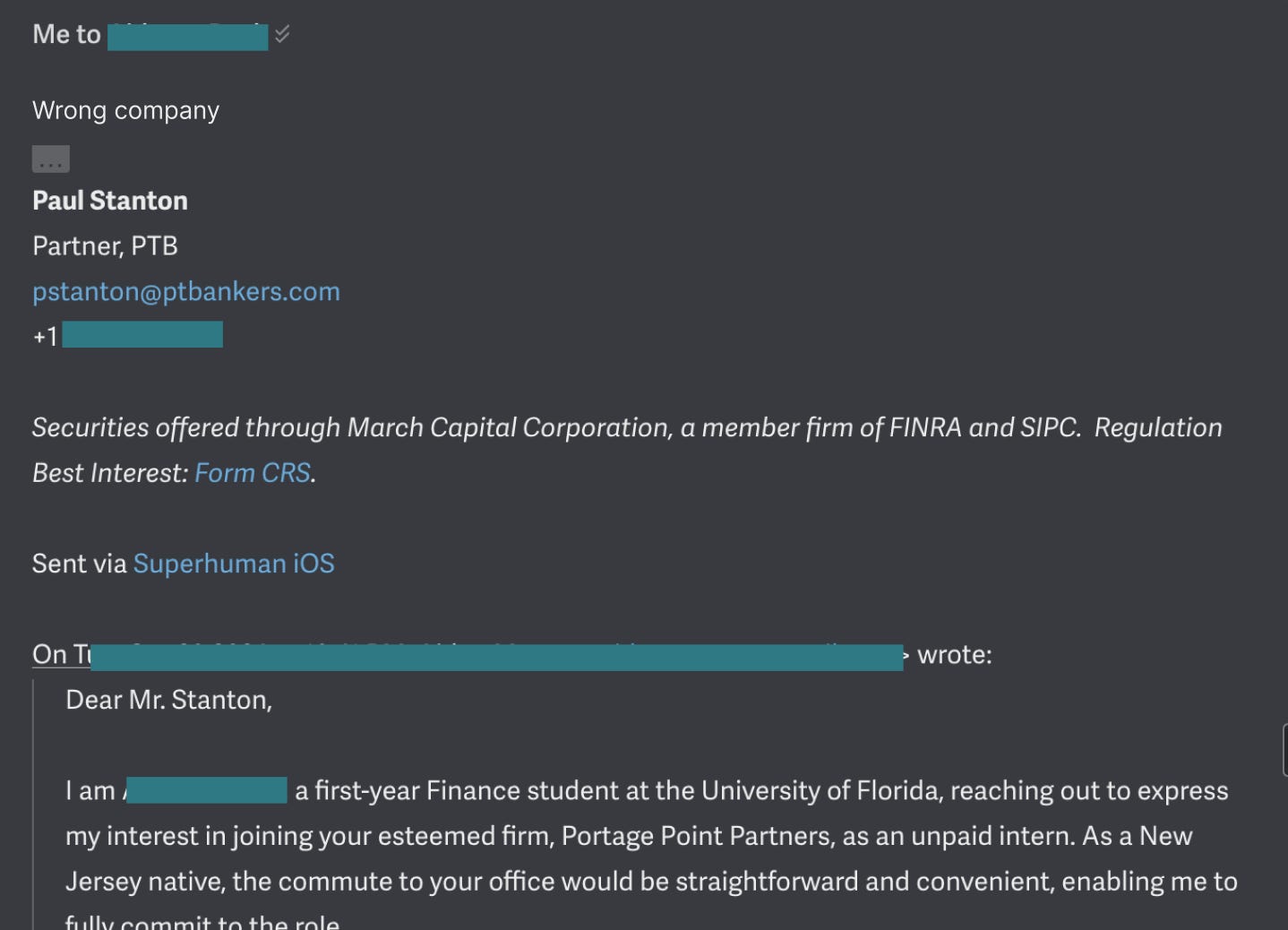
I get 10+ emails a week from college students asking for an internship. They all start with a paragraph about how much they admire our company (a company they clearly know nothing about, see above), followed by a PDF resume with a polite request to “learn from the best.”
Every one was written by ChatGPT (I can tell because they all use “moreover”)
As far as I can tell, the goal is to get an internship that pads a resume that gets them a soul-sucking real estate IB analyst seat that they’ll leave in two years. It’s the most expensive, least efficient path to a real estate career I can imagine. And I know, because I basically did a version of it.
Here’s how I got into real estate.
I was dating someone in college whose dad was a developer. I watched him build things and get paid a lot of money for it. That was the spark.
So what did I do with that spark? Absolutely nothing strategic.
I didn’t study real estate or learn to model. I didn’t read a zoning code. I basically just told people “I want to work in real estate” and waited for nepotism to run its course.
My friend’s dad got me a summer internship in brokerage and I got a full-time job off the back of it. I hated it. So I went to law school. I hated that too. Then I finally realized what I should have figured out on day one: I just needed to start putting small deals together myself.
It took me seven years and about $200k in law school debt to arrive at a conclusion I could have reached at 20 with a laptop and some initiative.
If I were 20 years old today—with access to Claude, the internet, and social media—here’s what I’d do instead of blasting cold emails or relying on nepotism.
Step 1: Build a curriculum with AI
Open Claude and design an independent study covering four things:
which real estate asset classes are most likely to be impacted by AI over the next decade;
the core development skills (financial modeling, zoning analysis, lease structuring, construction budgeting) and how to learn each one using AI-enabled tools;
how real estate capital markets actually work—who the LPs are, how funds are structured, how deals get financed; and
hands-on case studies where I underwrite real local projects, build business plans, and pressure-test assumptions.
I wouldn’t wait for a professor to assign this. I’d build it myself, then walk it into the office of the most entrepreneurial professor in my business school and say: “I built this. Will you sponsor it as an independent study and help me find a local developer to apprentice with?”
Step 2: Find a 4-plex
While doing the independent study, I’d find a small multifamily property… probably a 4-plex, a duplex, something achievable… and underwrite it. Then run the model, walk the property, talk to the city about zoning, get a broker’s opinion of value, and build a real business plan—not a classroom exercise.
The goal wouldn’t be to “get an A”… but actually do the deal.
Step 3: Document everything on social media
From day one, I’d post about what I’m learning… not necessarily polished thought leadership… just honest, raw documentation of a 20-year-old trying to figure out real estate in real time. Every week I’d share what I read, modeled, got wrong and what surprised me.
This would do two things.
First, it would build an audience of people who are rooting for me—from other students to real estate executives (I’d watch this all day long) to investors who find my curiosity and transparency compelling.
Second, it would create a founder-led brand before I’d even done my first deal. By the time I’m ready to buy that 4-plex, people already know me.
Step 4: Crowdfund the 4-plex
(This is the part that would have been impossible in 2007 and is entirely possible in 2026) I’d have spent months building an audience; documenting my learning publicly; and have built a real business plan on a real property. Now I would go to that audience and raise the few hundred thousand dollars to close the deal.
Step 5: Decide what’s next
By the end of 24 months, I’d have something that almost no 22-year-old in real estate has: a real deal, a real track record (even if it’s small), a public body of work that demonstrates how I think, and an audience that’s been following my journey from the beginning.
I could join an existing platform with credibility, or keep doing small deals and build my own portfolio.
Personally, I’d probably go try to take down a mobile home park.
Paul, the crowdfunded 4-plex step is the one that most people will scroll past as aspirational fluff — but you're right that the infrastructure actually exists now in a way it didn't fifteen years ago. The harder truth buried in your piece is that the credential path survives because it offloads risk onto institutions: a bank trusts the IB analyst seat more than it trusts the 22-year-old with a Substack and a duplex underwrite. The capital markets haven't fully caught up to the audience-as-track-record model yet, but they're getting closer. For anyone reading this who's early — what's the actual blocker: access to deals, access to capital, or just not knowing where to start?
this is great/hilarious - will be forwarding on to many students from whom we get outreach