

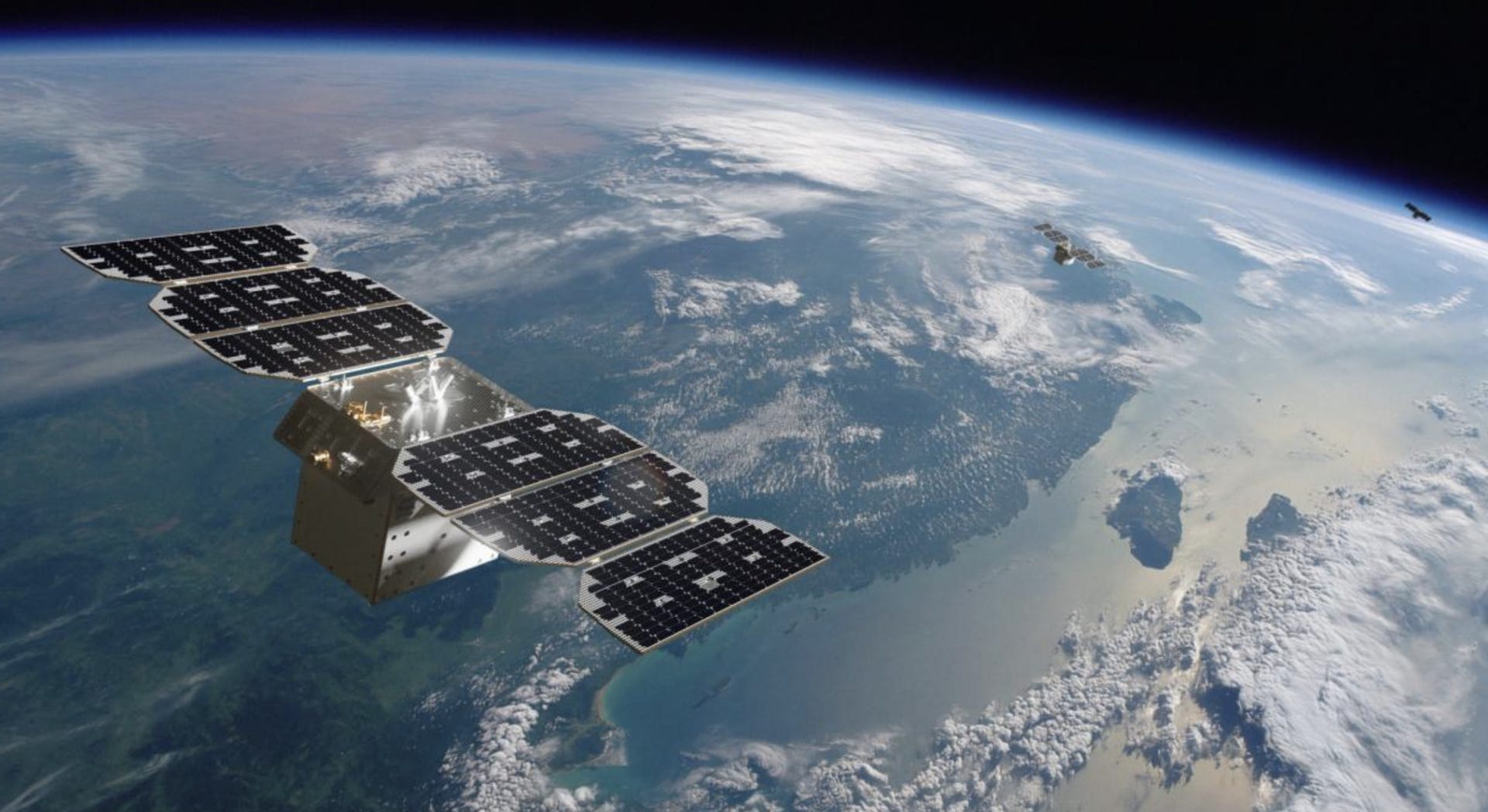
Elon Musk wants to put a million data centers in space.
Three months ago, SpaceX filed with the FCC for permission to launch up to one million satellites into orbit. Not for internet access (Starlink handles that)—for computing. These are solar-powered orbital data centers that process AI workloads in space, where energy is unlimited and cooling is free.
Around the same time, Musk proposed merging SpaceX with xAI in a deal valuing the combined entity at roughly $1.25 trillion. Then he outlined plans to build a a factory on the Moon to manufacture AI satellites and launch them into orbit using an electromagnetic catapult, leveraging the Moon’s one-sixth gravity and zero atmosphere to fling hardware into space at a fraction of the cost of a rocket.
He calls the vision a “sentient sun.”
I read all of this and realized I didn’t actually understand data centers well enough to know whether it was genius or insane. So I went down the rabbit hole.
What a data center actually is
Every text you send, show you stream, and question you ask Claude happens inside a building somewhere. A data center is essentially a warehouse full of servers that store, process, and transmit data. It’s to the internet what a power plant is to your light switch.
There are more than 10,000 data centers in the United States, ranging from edge facilities the size of a shipping container to hyperscale campuses covering millions of square feet at $1B+ per build. The tenants: Microsoft, Google, Amazon, Meta, Apple, Oracle, plus enterprise customers like banks, hospitals, and AI startups that lease smaller blocks from colocation providers.
The real estate model
At their core, data centers are a real estate business. Developers acquire land, build a facility, and lease to tenants on 10-to-20 year triple-net contracts. The economics look more like industrial net lease than office or retail.
The critical variable is power, not necessarily location. A hyperscale facility needs 100 to 300 MW, enough to run a small city. Securing that power from the local utility, often years in advance, is the single most important step. This is why data centers cluster in Northern Virginia (the data center capital of the world), Dallas, Phoenix, and Chicago, and increasingly in smaller markets where cheap power remains available.
The cocktail party insight: training vs. inference
AI models need to be trained, feeding trillions of data points into GPU clusters in a massively energy-intensive process. That’s what the current buildout is primarily serving.
Then there’s inference—every time you or I actually use the model. Every AI response, image generated, and voice assistant answer uses less power per query, but the volume is astronomical and growing exponentially.
Training is building the factory, and inference is running it 24/7. Some believe advances in model efficiency and chip design will dramatically reduce inference energy costs over time—which would reshape the infrastructure buildout. Others argue the sheer volume of queries will outpace any efficiency gains. Either way, the long-term investment thesis is focused on inference because that’s where the recurring, always-on demand lives.
How to invest
Four access points:
Public REITs: Equinix and Digital Realty are the dominant publicly traded data center REITs. Equinix operates 260+ facilities across 70+ metros globally. The challenge: they’ve already priced in a lot of the AI tailwind.
Private infrastructure funds: Brookfield, KKR, and Blackstone have raised massive funds to build and acquire data centers. Institutional scale, long time horizons, large minimums.
Niche operators: This is where it gets interesting for the Buy Box audience. Companies like Karis — featured at our recent Niche Industrial Pitch Night — acquire powered land and data center sites with 500+ MW of committed capacity across 2,800 entitled acres. The play: source the land and the power before the hyperscalers arrive.
Adjacencies: Power generation (especially renewables), cooling technology, fiber networks, and the construction firms building these facilities.
Why does Musk want to put data centers in orbit? Two words: power and cooling.
On Earth, data centers are hitting a hard wall; they consume more electricity than many countries, utilities can’t keep up with demand, and new power generation takes a decade to permit and build. Water for cooling is increasingly scarce. Every new hyperscale facility is a fight with local utilities, regulators, and communities.
In space, the sun never stops shining, solar panels generate energy 24 hours a day with no weather interruptions and the vacuum of space provides natural cooling without water or chillers.
Is it feasible? SpaceX itself warned investors last week that the plan “may never become commercially viable.” The technical hurdles — latency, maintenance, data transmission, and the physics of putting a million objects in orbit — are enormous.
But here’s what I take away as an investor: even if orbital data centers are a decade away or never arrive, the fact that the most ambitious company on the planet is trying to solve this problem from space tells you everything about how severe the terrestrial constraints have become.
Great piece. The thing I keep coming back to: we're adopting AI exponentially but building the infrastructure to support it on timelines that haven't changed in decades. And beyond the timelines, the actual resources (power, water, land) aren't infinite. None of that moves faster just because demand wants it to.