


Note: this is not tax or legal advice. Parts of this are grey areas, and I’m describing how others have done it, not telling you what to do. Hire a CPA and a real estate attorney before you buy anything.
A college friend of mine grew up in a family that had houses everywhere… Aspen, a farmhouse in the south of France, and a few other “shacks” that weren’t shacks. His dad is an infamous real estate character.
A couple weeks ago I asked him how his dad afforded all of it. He laughed and said his dad never believed he owned vacation homes. He believed he owned “hotels”.
The short background:
In the mid-90s his dad bought a ski house in Aspen. Rather than let his wife furnish it with an interior designer, he hired a local property manager, built a pricing sheet, and rented it out for Christmas, Presidents’ Week and most of July. Then the family got two two-week chunks to “book”, usually one prime stretch in the winter and summer at what they all called “the inn.”
Then he did it again in France, and again after that.
Over 30 years the houses paid their own carry and threw off tax losses against his other income. And appreciated the whole time. He sold a couple, swapped a couple, and kept the rest.
The family never skipped a trip, but the houses never got treated as pure vacation homes either. They got a business plan and a leather-bound logbook.
Here’s the playbook, as best I can recount it.
The trick is how you label the house
The IRS doesn’t care what you call a property. It cares how you use it. The same $2M house can be a personal second home or an investment property depending on a few numbers:
how many days it’s rented,
how many days you stay, and
how many hours you put in.
Personal second home:
you pay for everything with after-tax dollars,
you can deduct a some mortgage interest, and…
…you get nothing else.
Investment property:
guests pay most of the bills,
depreciation creates deductions, and
you may be able to use the losses against your other income.
Then you think of your own personal use as paying rent to your own house in calendar days.
Step 1: Buy it like a landlord
Check that you can rent it. Zoning, HOA rules and permits matter are more important than the view given some towns cap or ban short-term rentals.
Insurance. A standard homeowner’s policy often excludes short-term rentals, so get a policy written for them, and an umbrella on top.
Use an LLC. For liability… a single-member LLC is ignored for tax purposes, so nothing changes on your return.
Be careful with the loan. Second-home loans have lower rates than investment loans, but they come with occupancy promises. Check these, and confirm your “plan” is within them.
Step 2: Pass the seven-day test
Normally, rental losses are “passive,” which means you can only use them against other passive income (in other words, W2 or 1099 income from your job doesn’t count). For most high earners, that kills the tax benefit.
But there’s a workaround. If the average guest stay is seven days or less, the IRS doesn’t treat it as a rental activity at all. It’s treated like a hotel business. Then the question becomes whether you materially participate in running it. If you materially participate in running it, the losses are non-passive and can offset your W-2, business or other income. So be sure to control pricing, guest messages, hiring, supply orders, repairs.
Average stay is simple math: total nights booked divided by number of bookings. A few 14-night stays can break it, so cap your minimum and maximum stays.
Step 3: Focus most on depreciation
You can deduct the cost of the building over time, but not the land.
Standard depreciation is slow: 27.5 years for a long-term residential rental, and 39 years for a short-term rental, which the IRS treats as transient lodging.
This is where it gets most compelling.
A cost segregation study has an engineer break the building into components: cabinets, flooring, fixtures, landscaping, appliances. Many of those depreciate in 5, 7 or 15 years instead of 39. Under current law, bonus depreciation lets you deduct those short-lived pieces right away. Furniture and equipment you buy for the house qualify too.
On a $2M house, that can mean a roughly $500K paper loss in year one. It’s paper because you didn’t actually lose $500K. You just got to deduct it.
Two warnings: there’s a cap on how much business loss you can use against other income in a single year (roughly $300K single or $600K joint, indexed), with the rest carrying forward. And houses outside the US don’t get this. Foreign property depreciates over 30 years with no bonus, so the French house is a slower story.
Step 4: The 14-day rule
If you use the property personally for more than 14 days or 10% of the days it’s rented, whichever is greater, the IRS treats it as a personal residence. Then your deductions are limited to the rental income, and the big losses disappear.
BUT… days spent doing repairs or maintenance don’t count, if you’re “working on the house substantially full time” (see Step 5). You can’t claim to be working on it - substantially, full time - 100 days per year, but it can double the personal use number from 14 to 30.
(There’s a flip side. If you rent for fewer than 15 days a year, the income is tax-free and the deductions are gone. It’s for people who want an excuse to rent their house during the Masters.)
Step 5: Log your hours
To “materially participate,” you generally need to clear one of these:
500+ hours a year, or
100+ hours and more than anyone else (including your cleaners and manager)
So if you hire a full-service manager who works more hours than you do, you fail the test. The fix is to keep the operating decisions in your own hands: pricing, guest messages, hiring, supply orders, repairs. Use cleaners and handymen as contractors, and keep a contemporaneous log (dates, hours, what you did). A spreadsheet is fine, a your spouse’s hours count too.
Step 6: Travel
When you go to the property primarily to run it (inspect, meet contractors, install furniture, train a manager), the trip is a legitimate business expense: airfare, lodging, local transport and 50% of meals.
The key word is primarily. If you spend three days on business and four on the slopes, you allocate. The IRS has opinions about vacation homes and travel deductions, and this is the most audited part of the strategy. So keep a log and receipts. This is also the grey area your lawyer will want to look at.
Furnish it like a hotel, not a home
Rules from my buddy’s dad, as relayed to me and slightly expanded on:
Buy two of everything. Lamps, bath mats, remote controls. When one breaks, the house isn’t out of commission.
Performance everything. Crypton or Sunbrella fabrics, leather instead of linen, stone or quartz counters, durable rugs you can wash.
Hard floors, dark grout, washable paint. Keeps bad stains away.
Three sets of linens per bed. One on the bed, one in the wash, one on the shelf.
An owner’s closet. A locked closet for your art, personal items and the good wine.
Smart locks and noise sensors. No-party rules, a damage deposit, and a platform with host protection.
Buy furniture as a package, and keep every receipt. Furniture is one of the fastest deductions in the whole strategy.
The 10-year scoreboard
Here’s the same $2M house, owned for 10 years as a personal second home vs. a short-term investment property.
About a $2mm spread if 1031’d at exit.
Assumptions: 25% down, $1.5M interest-only loan at 6.5%, 4% annual appreciation (about $2.96M at sale), 6% selling costs. Investment case: $180K gross rent, 45% operating costs, $20K property tax, $8K insurance, 25% of building cost-segregated, $100K of furniture. Top federal bracket (37% ordinary, 23.8% on gains), married filing jointly, no state tax.
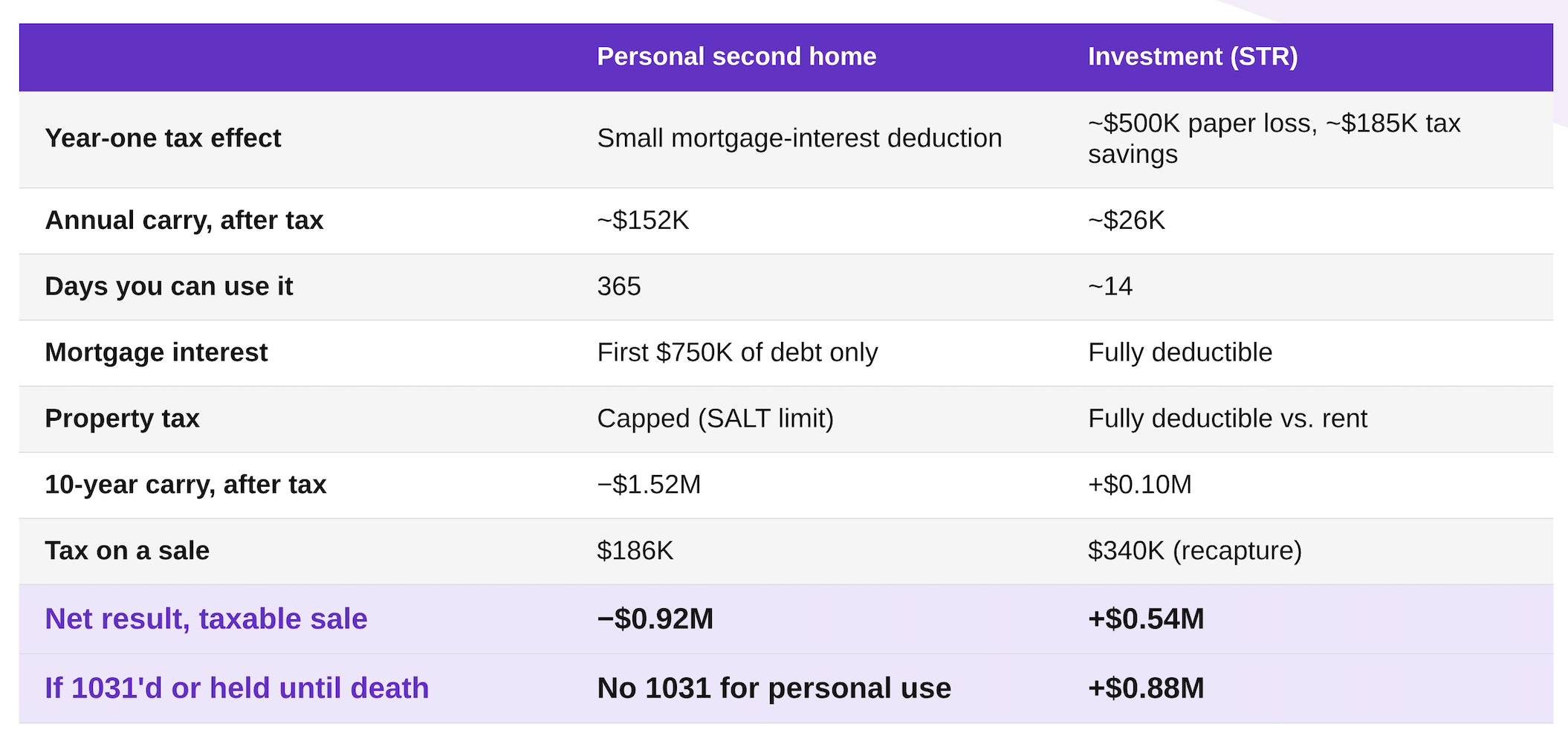
Two things to note.
First, the investment property costs more in tax when you sell. Depreciation gets “recaptured” at up to 25% (and the furniture and short-life items can be taxed at ordinary rates). The strategy isn’t free money, it’s a trade: take the deduction now at 37%, pay it back later at about 25%, and use the money in between.
Second, the real difference is the carry. In the personal version, you pay about $152K a year. In the investment version, guests and the IRS pay most of it. You’re not getting richer, you’re getting a house that mostly pays for itself, and you’re paying with your calendar.
The exit
Sell it. You pay tax on the gain, plus recapture. The personal home exclusion ($250K/$500K) doesn’t apply to a second home or an investment property.
1031 exchange. Swap into another US investment property and defer all the tax. If the house was a vacation home too, there’s an IRS safe harbor: hold it 24 months, and in each of those years rent it at fair value for 14+ days and keep your personal use under the 14-day/10% limit. Nothing swaps out of France into US property, or the reverse.
DST. A Delaware Statutory Trust lets you roll the proceeds into a passive stake in institutional property, and it’s a legitimate 1031 destination. It’s passive, so the STR loophole doesn’t apply to it.
Hold until death. Your heirs get a stepped-up basis, and the deferred gain disappears. The old line is “swap until you drop.”
One rule above all others
Log everything. Every night booked, night you stayed, hour you worked and every trip you took. The strategy rests on records that were written in real time (“memory” does not survive an audit).
My buddy’s dad’s logbook was the best-kept document in the family.