

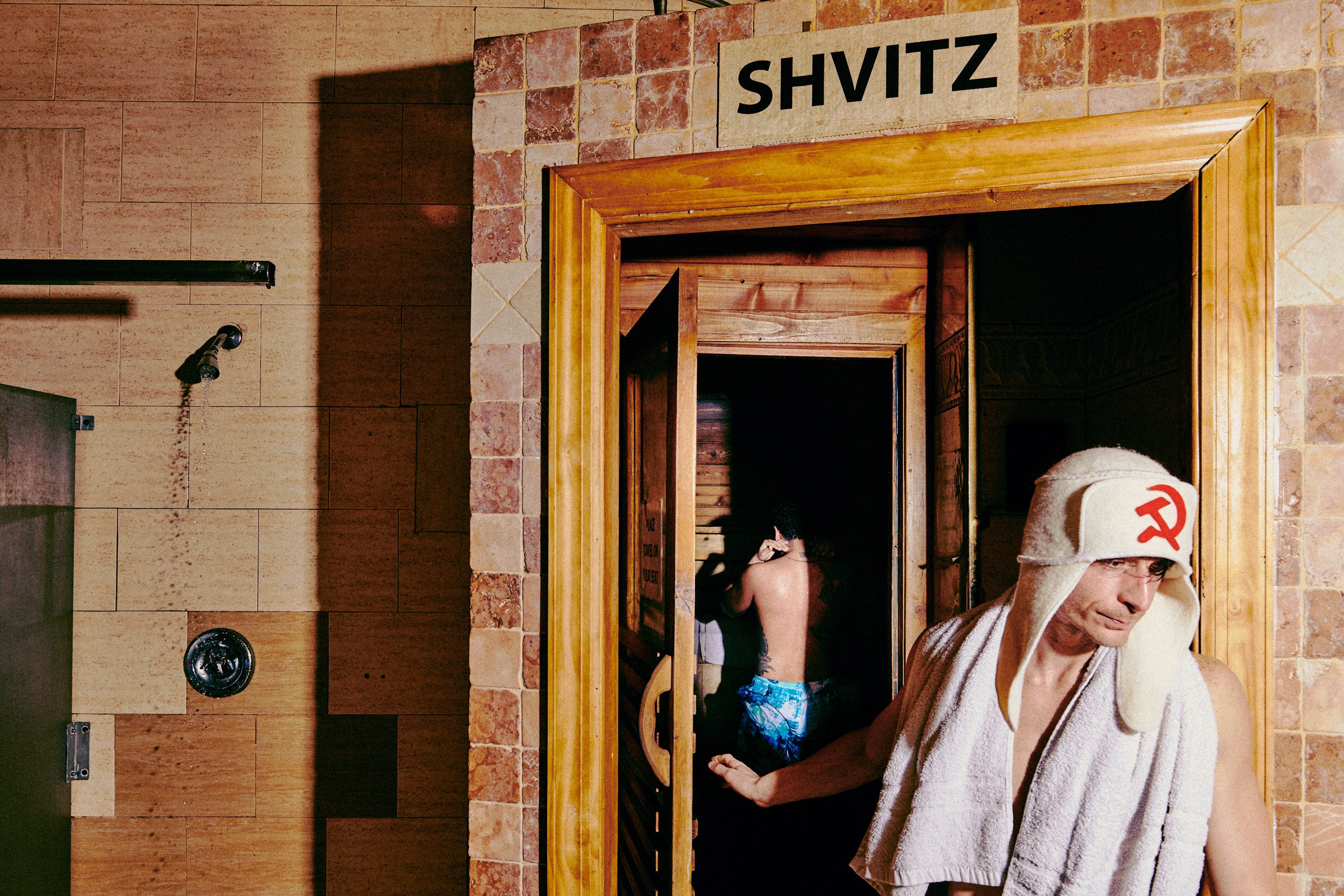
There is a place on East 10th Street where time doesn’t exist.
You walk through a door that hasn’t been renovated since the Clinton administration; descend a staircase that smells like eucalyptus and dryer sheets; and suddenly you’re a 19th-century immigrant getting schvitzed by a 260-degree Russian steam room and a guy named Boris holding oak leaf branches. The Russian & Turkish Baths have been open since 1892. The WiFi doesn’t work. It’s perfect.
I’ve been going for a decade.
Not in a “I discovered cold plunge before Huberman” way—more in a “my friend dragged me there hungover in 2014 and I became a person who goes to a bathhouse” way. Once a month, sometimes more, I’d pay my $45, stuff my phone in a locker that doesn’t lock, and cycle through steam, sauna, cold plunge, repeat. No app. No branded robe. No “intention-setting breathwork session.” Just hot, cold, and the most democratic cross-section of humanity you’ll find in Manhattan: old Russian men, finance bros in mid-existential crisis, downtown artists, supermodels, and the occasional tourist who wandered in looking for a speakeasy.
I love it. And I love it more every year, because every year the world gets louder, more online, more optimized. The bathhouse is none of those things. It’s a millennia-old practice—Romans, Ottomans, Japanese, Scandinavians, Russians—all figured out the same truth: sweating in a room with other people is good for you.
The science backs it up now, too. Regular sauna use is linked to reduced cardiovascular mortality, improved circulation, and lower rates of dementia. Dr. Rhonda Patrick has made a career of explaining why heat stress is basically a free longevity hack. But I didn’t need a podcast to tell me that. I needed Boris.
Wall Street Bath, better known as Spa 88, runs the same playbook downtown. No frills. Russian and Turkish rooms. A cold plunge that makes you question your life choices. Maybe $50. The crowd skews Financial District—traders unwinding, older regulars who’ve been coming since before the building next door was a condo. These places operate on thin margins, modest build-outs, and decades of community loyalty. They’re not businesses you’d pitch to a VC. They’re businesses that just... exist. Stubbornly, beautifully.
So when I tell you that venture-backed bathhouses are now raising money at eye-watering valuations, you’ll understand my complicated feelings.
Enter the New School
Bathhouse, in Williamsburg, opened in a restored 1930s warehouse and immediately became the kind of place that fills your Instagram Explore page.
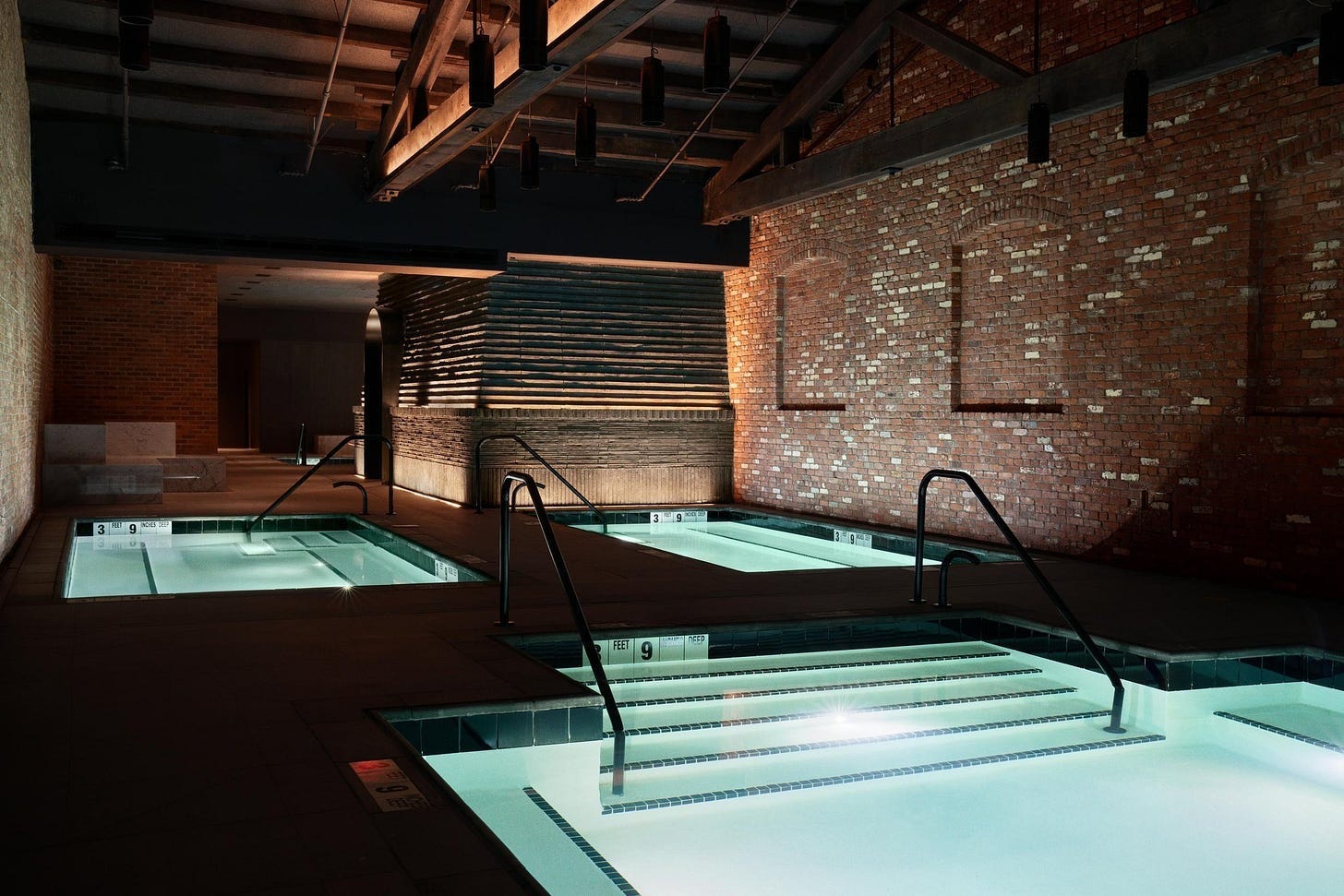
Bathhouse in Williamsburg
The design is stunning—think Japanese minimalism meets Brooklyn industrial, with hot and cold pools, multiple sauna rooms, a restaurant, and a generally gorgeous vibe. They’ve reportedly raised north of $40 million.
Othership, which started in Toronto, combines sauna sessions with guided breathwork, live DJs, and what they call “transformational experiences.” They’ve raised significant venture capital and have aggressive expansion ambitions across North America.
Lore Bathing Club is the latest entrant, positioning itself as a members-only social wellness club—bathhouse meets Soho House, but without trying to be exclusive (I’m actually most bullish about both this business model & concept).
I get the thesis. I genuinely do. As someone who invests in niche real estate concepts for a living, the demand signals are screaming.
The sober-curious movement is real—more people want intense, physically engaging social activities that don’t revolve around a bar.
The loneliness epidemic is real—people want third places that aren’t a coffee shop or a gym.
The longevity trend is real—sauna, cold plunge, and heat therapy are no longer fringe. And phone-free spaces? In 2026? That’s not a feature, it’s a luxury good.
The business model is attractive—these new concepts are essentially premium experiential fitness meets hospitality.
Memberships range from $100 to $200+ per month, with day passes running $60-$100.
Revenue stacks include retail (branded towels, supplements, skincare), F&B, events, and private bookings.
The build-out costs are significant at $500–$800+ per square foot—plumbing for multiple temperature-controlled water features, commercial-grade HVAC, and high-end finishes,
The unit economics are very compelling at scale, with high throughput and strong membership retention.
But compare that to the old guard. The 10th Street Baths operate on what I’d generously call a “legacy cost structure.” They’ve been in the same space for over a century. The rent, whatever it is, is from another era. The build-out is paid for many times over. They don’t need 2,000 members at $150/month to make the model work. They need regulars who show up, pay at the door, and maybe buy a Platza treatment for an extra $40.
The Question I Keep Circling
Can the new school replicate the thing that actually makes bathhouses special?
Not the sauna. Not the cold plunge. Anyone can install those. It’s the communal authenticity—the randomness of who’s in the room, the lack of curation, the fact that nobody is performing wellness, they’re just... doing it. The 10th Street Baths are not an experience. They’re a place. There’s a difference.
The new bathhouses are undeniably experiences. They’re designed to be. And that’s both their strength and their vulnerability.
The comps that get thrown around in pitch decks are Barry’s, Equinox, SoulCycle.
Those are exercise concepts with clear, repeatable, high-frequency use cases. You go to Barry’s three times a week because the workout changes. A bathhouse session is more or less the same every time. That’s the beauty of it, but it’s a retention challenge when you’re charging a premium. The ancient bathhouse model solved this by being cheap, local, and habitual. The new model needs to solve it with programming, community events, and brand loyalty.
I’m not betting against the category. The macro trends are too strong, the consumer appetite is too real, and some of these operators are incredibly thoughtful about what they’re building. The ones that will survive are the ones that figure out they’re not really in the sauna business—they’re in the community business. And community, as the old-timers on 10th Street could tell you, can’t be fundraised into existence.
It has to be sweated out.