


Alongside sharing interesting real estate themes and stories in my letters, I’m going to start fleshing out what I think is the biggest opportunity I’ve seen in my real estate career:
The industry’s shift toward creating real estate investment products for the taxable investor - families, founders and operators investing their own money.
This letter breaks down why it’s happening.
TL;DR
Real estate GPs - the people & organizations who find and raise money for real estate investments - have historically focused on big institutions as their LP investors because they can write big checks ($20mm-$1bn+)
These pensions, endowments, sovereign wealth funds, etc. are tax-exempt and don’t care about all the tax advantages of real estate investments, i.e., what taxable investors care about
Thanks to this tax-exempt customer focus, most real estate investment vehicles today are not designed for the taxable investor
But that’s changing… (1) institutions are consolidating to the largest real estate investment managers, while (2) the growth of the taxable investor class is exploding via wealth transfer and wealth creation
So, many of the real estate GPs that used to build investment products for pension funds are starting to build products for high-net-worth families
Thus, the thesis: over the next 5 years, we will see a wave of new real estate products for taxable investors — built specifically for individual outcomes with better transparency and education around the product offering.
Start with who the customer was
When a pension fund, a university endowment or a sovereign wealth fund buys a building, it pays no income tax on what that building earns. That’s the bargain Congress made: retirement savings and charitable endowments compound untaxed.
But nearly every feature that makes real estate attractive to a person is a tax feature.
Depreciation lets you report a loss on paper while cash is landing in your account. A 1031 exchange lets you sell a building, buy another, and owe nothing that year. Hold the thing until you die and your children inherit it with the gain wiped clean.
To a pension fund, that entire list is worth zero. You cannot take a deduction against income you don’t have.
So the industry did the rational thing and built products optimized for everything except taxes.
Funds with a fixed ten-year life, because a fixed life produces a clean return number a consultant can benchmark
Quarterly valuations, because allocators have to report something every quarter
Corporate wrappers sitting between the investor and the building, because borrowed money creates a tax bill even for a tax-exempt buyer, and real estate runs on borrowed money.
All of that works. And none of it was designed against individuals.
It simply wasn’t designed for them.
Three reasons the benefits don’t come along
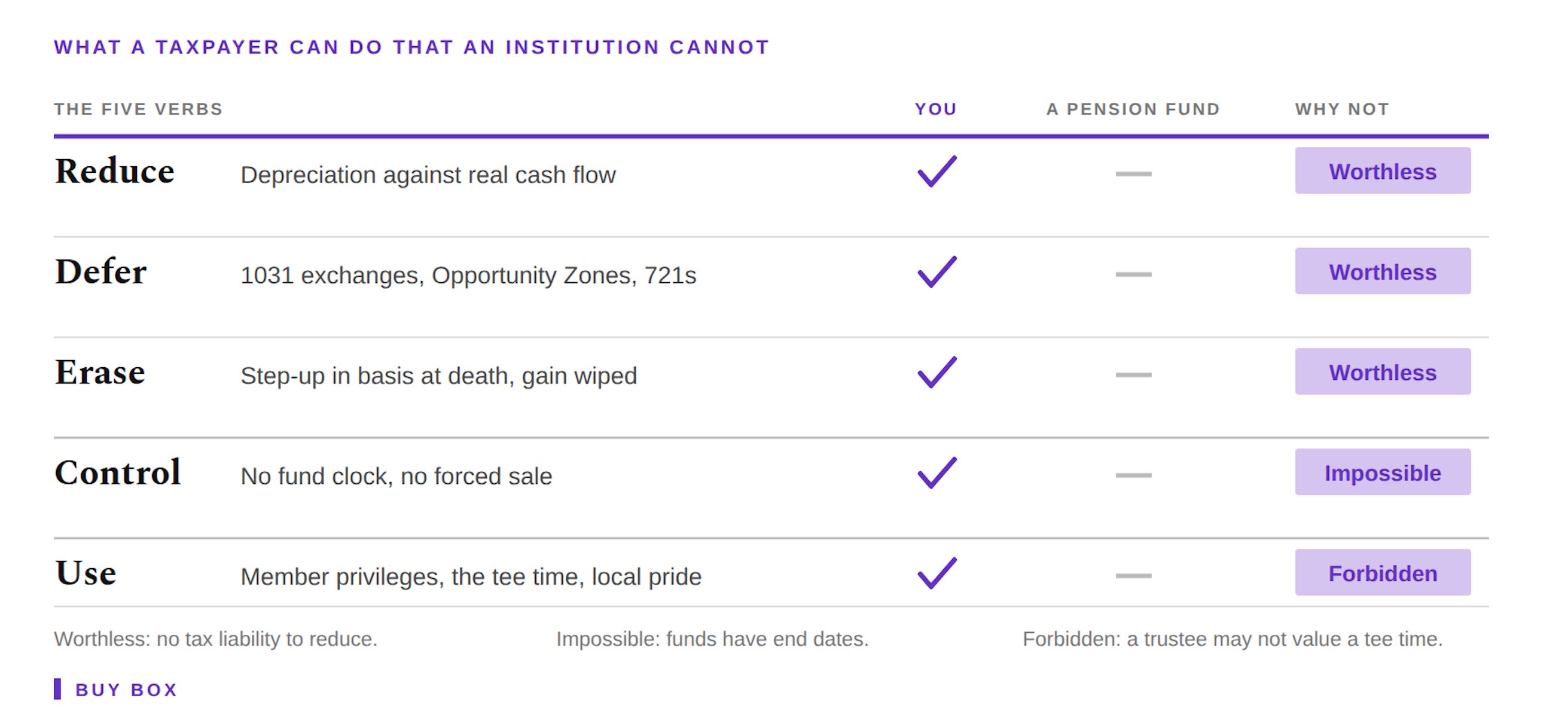
1/ Some of what a taxpayer can do is worthless to an institution.
Reducing a tax bill through depreciation
Deferring one through a 1031 exchange
Erasing it through a step-up at death
All meaningless to a pension fund.
2/ One thing is forbidden to institutions.
Using the real estate for personal use… the pension trustee has a legal duty to act solely for the financial benefit of the people whose money it is. So a trustee cannot pay an extra dollar because the ski resort comes with member privileges, or because it’s a building on the main street of his hometown and he’s proud to own it. He is not permitted to want those things.
3/ And one thing is impossible.
Institutional money runs on clocks. Funds have end dates. Allocation policies force selling when the stock market falls and real estate suddenly looks too big a share of the portfolio.
Taxable investors have no clock and no policy, so you can hold forever and sell when it suits you.
Worthless, forbidden, impossible. That’s the complete list of what a taxable investor owns and a tax-exempt one doesn’t, and it compresses to five words: reduce, defer, erase, control, use.
Why it’s turning now
Three things are happening at once.
1/ Institutional capital is consolidating hard. The twenty largest real estate investment managers (think Ares, Blackstone, Carlyle, etc.) now take roughly half of all closed-end real estate fundraising, up about five points in a decade, and 17% of institutions say they intend to shrink the list of managers they work with. So if you’re not top twenty, that channel is closing.
2/ Wall Street’s answer for individuals hasn’t worked. Non-traded REITs, the packaged retail product, raised $5.7 billion in 2025, down more than 80% from the 2021 peak. That isn’t a demand problem. Individuals want this asset class. It’s a product problem: those vehicles charge for daily liquidity that most individual buyers will never use, and deliver none of the five verbs - reduce, defer, erase, control, use.
3/ And the money is changing hands. Cerulli estimates $124 trillion moves between generations through 2048. Estimates vary wildly and I wouldn’t defend that specific figure, but the direction isn’t in dispute.
So we’re living at an intersection with: (a) strong operators who need new capital + (b) a growing cohort of taxable investors - families, founders, operators’ own money - who need the tax advantages of the asset class.
If you’re the one investing
Two questions...
How many layers sit between me and the building?
Five things can be in there: an advisor’s platform, a fund, a corporate wrapper, a sponsor, an operating team.
Each takes a fee, or a right, or both. The ones that take rights are the dangerous ones, because they don’t show up as a fee in year one. They show up three decades later as a tax bill for your children.
What’s the after-tax return?
Not the IRR. The after-tax number, for someone in your bracket, in your state, with the depreciation schedule attached.
A sponsor who built the product for individuals will have it ready and be pleased you asked. One who didn’t will send back a pre-tax return measured against an index you have no stake in, and you’ll have learned more from the dodge than you would have from the answer.
If you’re the one raising
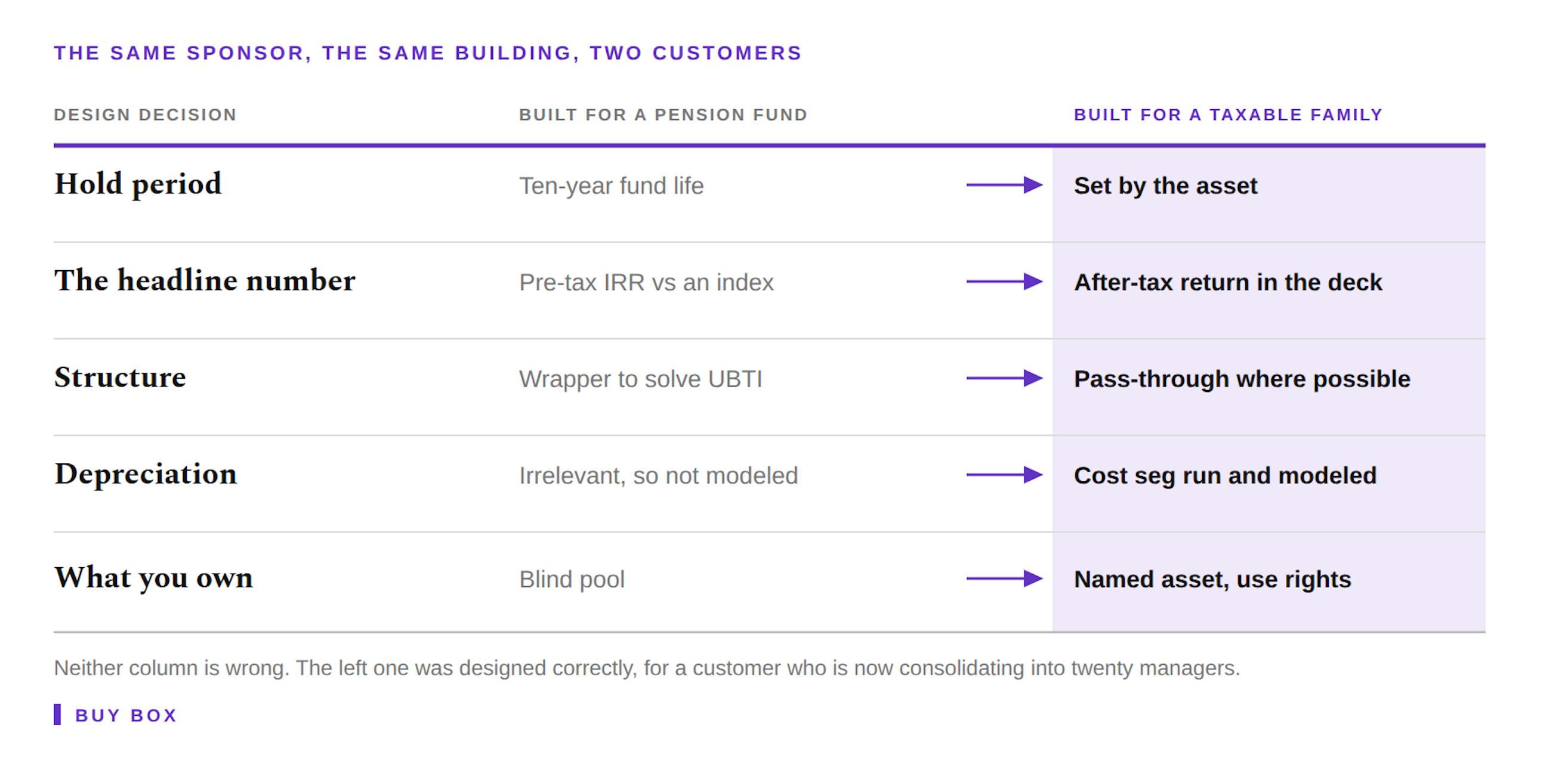
If you’ve spent a career raising from institutions, the opportunity here is not to market harder to individuals. It’s to build a different product.
Concretely: no wrapper where none is needed.
A cost segregation study run and modeled
An after-tax return in the deck
A hold period that isn’t governed by a fund clock
Use rights where the asset supports them
Almost nobody does this today, because existing tax-exempt LPs never needed it.
The trust problem also changes shape.
Something like 99% of private real estate capital has always moved through personal introduction, and there’s a legal reason for that: until 2013, publicly soliciting investors for a private deal was effectively off limits. It no longer is.
Trust can be built in public now, through teaching rather than through a shared dinner table, and the operators who start building an audience this year are the ones who will be able to raise from it in three.
The rule of thumb
Count the layers, then ask for the after-tax number.
If a sponsor answers both without flinching, they built it for you.
If they can’t, they built it for someone else.
Buy Box is written for taxable capital: families, founders, family offices, and operators investing their own money. Nothing here is tax or legal advice, and every situation turns on facts this letter doesn’t know about yours.
Sources: US CRE investable universe and institutional-quality share, Clarion Partners (H1 2025). Manager concentration and non-traded REIT fundraising, McKinsey Global Private Markets Report 2026. Generational wealth transfer estimate, Cerulli Associates.
Hi Paul, astute observations. Agree that an evergreen partnership model with quarterly liquidity is Goldilocks. Non traded REITs were popular for a reason but they’re too big and too diversified and REIT is a bad structure for taxable investors. We’ve launched a housing oriented vehicle like this in the PNW.