

In 2019, two men bought hotels in the same Florida town.
Harold bought the Seabreeze.
Ninety rooms on the beach, rooftop bar, infinity pool, sixty employees, and a sommelier named Julien who described wines as “architectural.” It made the cover of the local magazine.

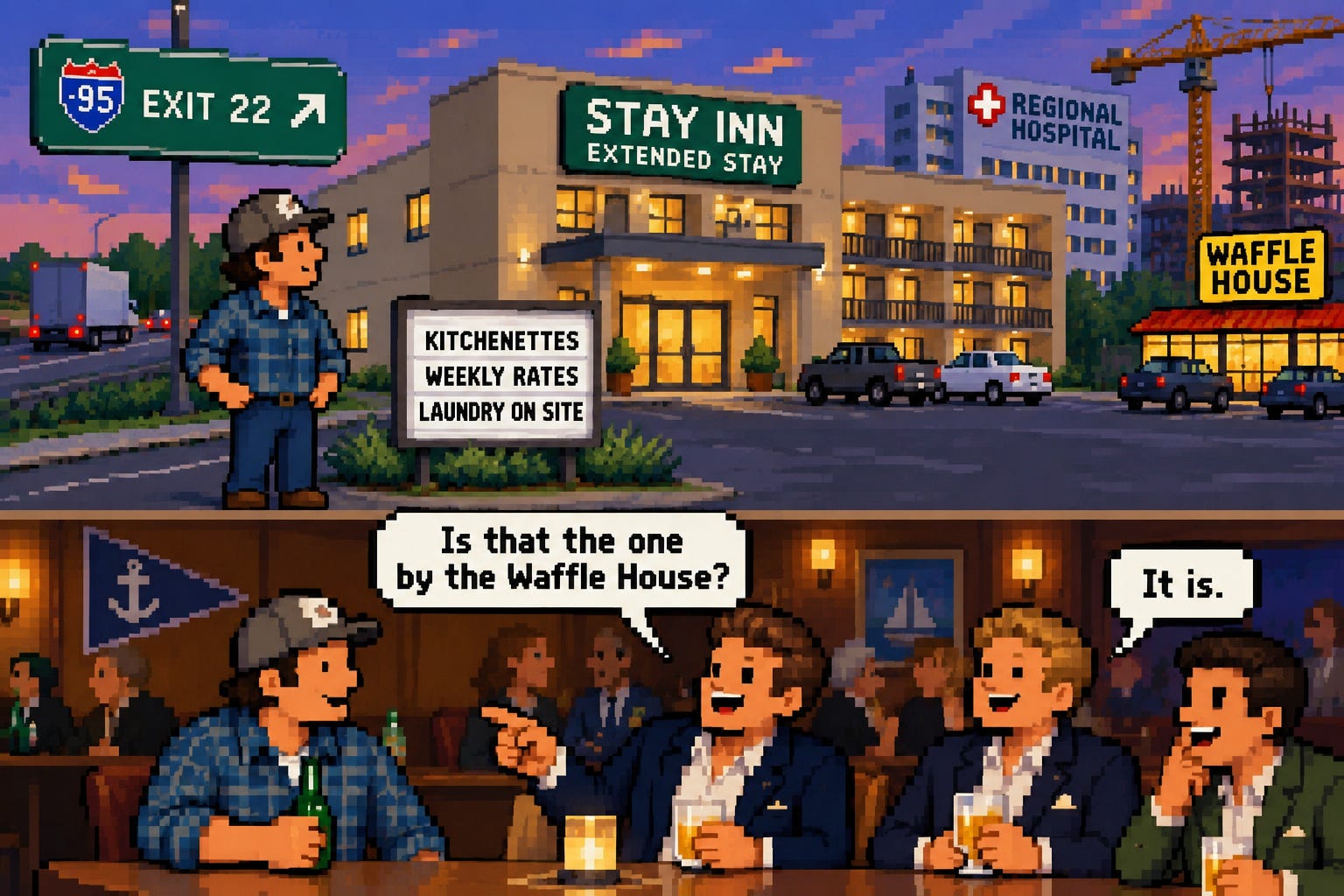
Meanwhile, Frank bought a beige box by the interstate, between the hospital and a construction site. An economy extended stay hotel.
A hundred and twenty studios with kitchenettes. Eight employees. The lobby had a waffle machine and a laminated sign about laundry quarters. When Frank mentioned it at the club, someone asked, “Is that the one by the Waffle House?” It was.
Then March 2020 arrived.
Harold’s phone rang first. A wedding, a bachelorette party, a dental convention, a couple from Ohio who had come every spring since 1994. All canceled. Tourists, Harold learned, are wonderful customers with one flaw: they can always not come.
By April, Julien was drinking the architecture himself.

Frank’s phone rang too.
The hospital needed rooms for traveling nurses, thirteen weeks at a time. Then the contractor called: the crew on the new hospital wing was essential and needed beds. Then a family whose apartment had flooded. Then a lineman crew in town to rebuild the grid.

Frank stayed full. His biggest problem that spring was the waffle machine.
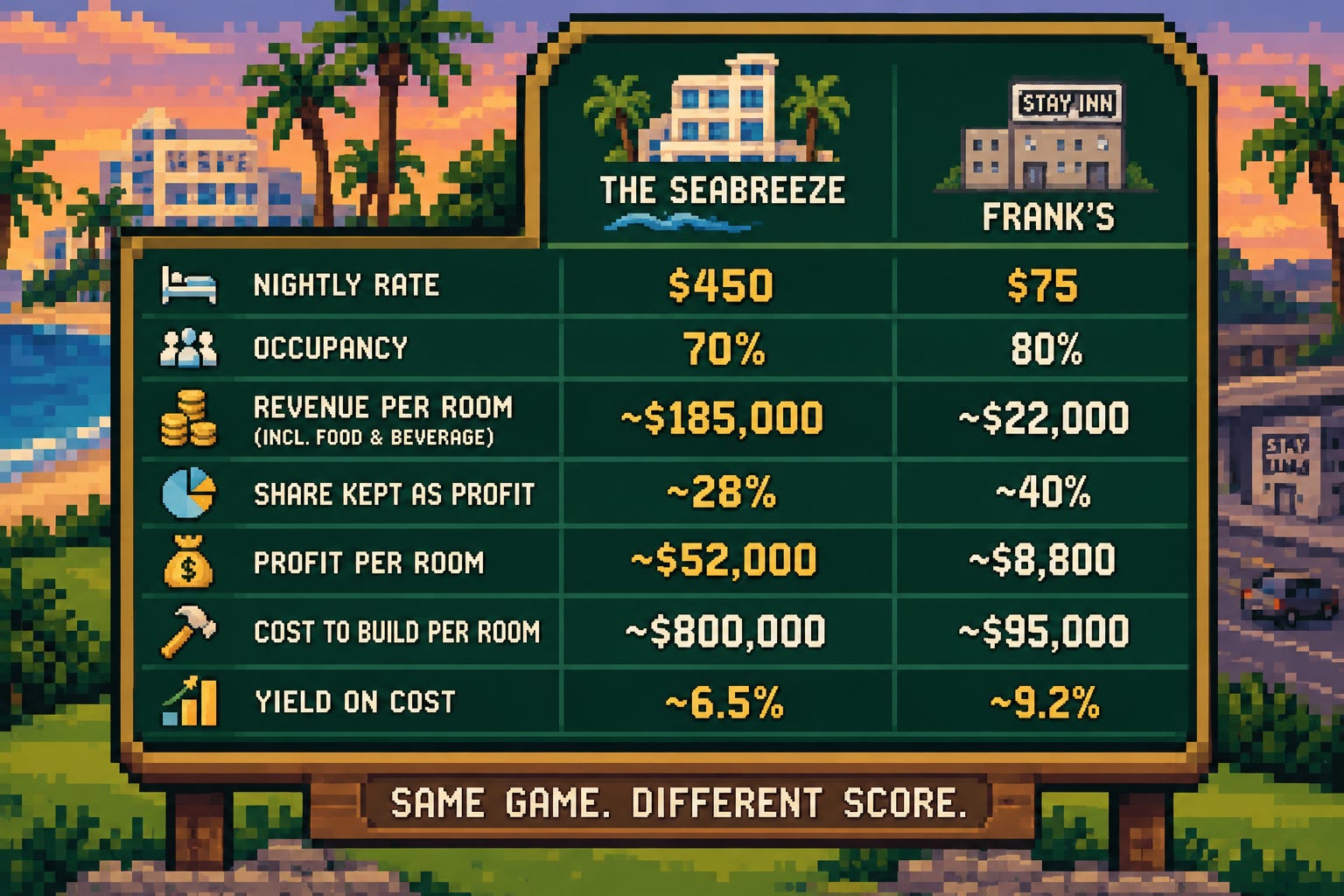
That summer, Harold found Frank on their club’s empty golf course and asked how. Frank took a scorecard and a pencil, and in the space for the back nine wrote: 28 vs. 40.
You keep 28 cents of every dollar. I keep 40.
Two years later, Harold bought a beige box of his own. He kept Julien on as GM. Julien now fixes the waffle machine, and he describes it as architectural.
The math behind the waffle machine
The parable is simple. The economics under it are more interesting, and there are four parts.
1. The margin is the moat
The Seabreeze makes six times the profit per room, and it costs more than eight times as much to build. Every amenity that justifies a $450 rate also needs payroll, and most of that payroll doesn’t go away when the rooms empty.
That’s why the margin matters more than the rate. If revenue falls 10% and costs stay the same, a business keeping 28 cents loses about 36% of its profit. A business keeping 40 cents loses 25%. The lean building absorbs the same shock with far less damage, and in practice its revenue falls less to begin with.
2. Long stays: a hotel that lives like an apartment
Frank’s average guest stays weeks, not nights. That changes three things.
Costs drop. There’s no nightly room turn, no daily housekeeping and little front-desk churn. That’s how eight people run 120 rooms.
Revenue stabilizes. One nurse on a 13-week contract replaces about 40 separate tourist bookings. Occupancy acts like an apartment building’s, not a resort’s.
Rent is at a premium, and reprices. Even at a discounted monthly rate of around $1,800, a 300-square-foot furnished studio earns about $6 per square foot per month. A local 750-square-foot apartment renting at $1,500 earns $2. Guests pay the premium because there’s no lease, credit check, deposit, furniture or utility setup. And unlike an apartment locked into a 12-month lease, Frank can reprice every week.
In short, Frank gets rent like a hotel and stability like an apartment.
3. The tax code likes furniture
For tax purposes a hotel building is written off over 39 years, which is slow. But a hotel is full of things that wear out fast: beds, TVs, kitchenettes, signage, parking lots and landscaping. A cost segregation study separates those items into 5-, 7- and 15-year categories. Since 2025, 100% bonus depreciation is back and permanent, so all of those items can be deducted in year one.
Hotels are unusually rich in these components. On a typical deal, a meaningful share of the purchase price can be reclassified. Depending on leverage, an investor might see a first-year paper loss equal to a large fraction of what they put in, while the property is sending them real cash.
Three caveats to know before you get excited:
As a passive investor, those losses offset passive income, like other real estate or K-1s. They don’t offset your salary unless you qualify as a real estate professional. Unused losses carry forward.
Depreciation is partly a timing benefit. When the property sells, some of it is recaptured, and the portion from furniture and fixtures is taxed at ordinary rates.
Don’t buy it in an IRA. The tax shield is wasted there.
The discipline rule: the deal has to work with zero tax benefit. The depreciation is the cherry, not the sundae.
4. The K-shaped economy fills Frank’s rooms
The economy has split into a K. The top arm is spending freely. The bottom arm is squeezed.
The top of the K books the Seabreeze. The bottom of the K lives at Frank’s.
Demand from the lower arm is growing for structural reasons:
A mobile workforce. Onshoring, data centers, grid upgrades and hospital staffing all send workers to towns that don’t have enough places to house them, often for months or years.
People priced out of the front door. Plenty of working households can afford $1,800 a month, but not first month, last month, a deposit, a credit check and a houseful of furniture. For them, extended stay beats both the apartment and the motel.
Shrinking supply. Old economy motels are being torn down or converted to housing, and new ones rarely pencil out.
The K has also hurt budget leisure hotels, because lower-income families cut vacations first. That’s the tourist problem again, just at a lower price point. The lesson isn’t “buy cheap hotels.” It’s to buy the rooms people need, at a price the bottom of the K can pay.
What to ask before you invest
What is the average length of stay? What share of revenue comes from stays of 7+ and 30+ nights? The longer the stays, the more it behaves like housing.
How concentrated is the demand? What share of revenue comes from the top five accounts, and what happens when that plant or hospital wing is finished?
What are staff per room and costs per occupied room, and which way are they trending? Margin drift is how good hotels become mediocre ones.
What did this segment, and this submarket, actually do in 2008 and 2020? Ask for real numbers, not projections.
What’s being built within five miles? Too many beige boxes in one town is how a good idea stops working.
Can I see the cost segregation estimate and projected K-1 losses by year? Then compare them against your own passive income.
Does it work with zero tax benefit? If not, walk.
Before you fall for the infinity pool, go find the waffle machine.