

Brad and I recently sat down with our buddies, Nick Clark and Dawson Williams, to talk about the redevelopment of a distressed office campus into a families-only country club in East Dallas called Stonethrow.
From an investment perspective, the deal checks our boxes for a project that is high-yielding, innovative, and has downside protection:
Deeply discounted acquisition ($12 PSF);
Secured construction financing;
Recurring-revenue model with strong pre-opening demand (1,000+ applications and 600+ families vetted, approved and paid initiation fees well ahead of opening);
Projected ~20%+ unlevered yield on cost; and
Ability to invest in both the OpCo & PropCo (can capture future upside of the operating business)
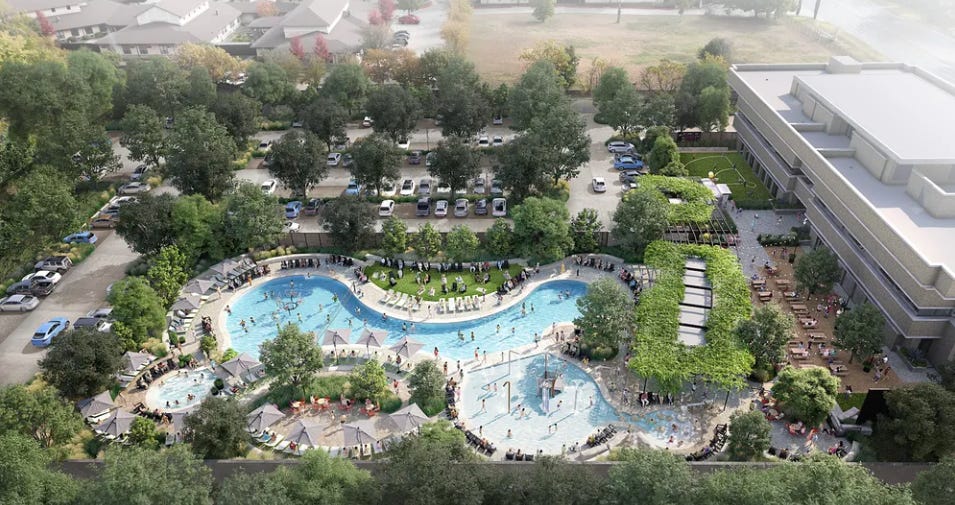
But the primary reason we’re investing: Nick and Dawson. We met them almost a decade ago when they were building Common Desk—which they scaled to 23 locations across 13 cities before exiting to WeWork in 2022.
From our front-row seats to that journey, this is what we’ve learned about them:
When venture-backed coworking companies were lighting money on fire, Nick and Dawson were bootstrapping and value-engineering.
Coworking circa 2014 (i.e., the WeWork heyday) attracted billions of venture dollars to fund leases, space build-outs, and on-site operations.
In hindsight, this was incredibly stupid—these coworking brands were hospitality operating companies with thin margins, not 100x SaaS platforms.
While WeWork, Industrious and Convene took the lion’s share of the money and the headlines, Common Desk saw the red flags and stayed 100% bootstrapped, structured hotel-style management agreements instead of leases, and value-engineered every build-out (when WeWork was spending $250 per square foot, Common Desk was spending $80 per square foot and delivering equally beautiful spaces) so that the unit economics of every location were profitable.
This takes an insane amount of skill, man-hours, and discipline/obsession. And in the end, they were the only guys (other than Adam Neumann) who actually made money in this niche category.
They build cult-like followings, because people love them.
In 2017-18, I spent 100+ hours in Common Desk locations and knew every early team member by name (up until they grew beyond 40-ish employees). And every team member believed they were Nick’s best friend—or part of his family.
This insane loyalty—which drove every staff member to go above and beyond their roles and responsibilities, especially in how they delivered hospitality—was what allowed Common Desk to succeed in filling its first locations (with no venture dollars).
This is a critical skillset in any operationally-complex business, and will be critical in family-focused social clubs as well.
Also, per the video clip above, they always took care of their employees before themselves, and I know they’ll do the same with investors.
They’re ruthless in managing construction costs and operating expenses.
While they don’t have traditional construction and development backgrounds, they have decades of experience managing large, complex design projects. And while I’ve met tons of creative hospitality operators who can fill rooms and hit top-line revenue targets, there are very few who are obsessive about their operating margins.
Nick and Dawson have done both of these in an incredibly difficult industry.


